

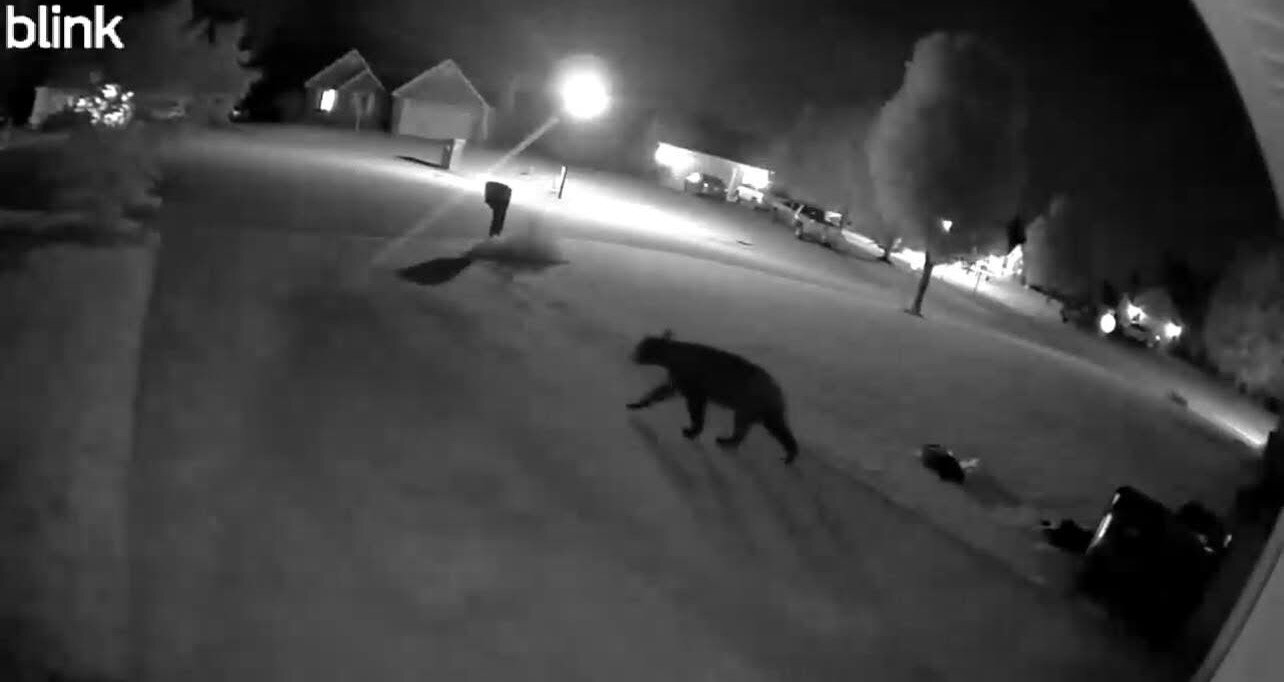


Click link for video of one sighting:
https://www.facebook.com/share/v/1CbUYRZr25/?mibextid=wwXIfr
The Kentucky Dept. of Fish of Wildlife told the Advocate this week it is aware of multiple black bear sightings in Mt. Sterling and Montgomery County recently.
Some individuals have captured photographs and video of at least one young black bear wandering the community.
A bear has even been sighted within city limits. A Ring camera captured video of a bear in the Sunset Ridge neighborhood Saturday evening. A still shot was shared by the Mt. Sterling Police Dept. Sunday on its social media page.
Police warned, “If seen, do not approach the animal and notify dispatch or Kentucky Fish and Wildlife.”
KD Sallee shared a video Sunday on social media of a bear at the end of Foster Branch Road in Hope. There was another reported sighting over the weekend near Pilot and the 113 I-64 exit as well as on Fogg Pike near La Croix subdivision, according to posts on the Advocate’s social media page.
Last week, Roy Cox, contacted the Advocate about a sighting he had near his Strange Road residence in Jeffersonville.
“I never thought I’d encounter a black bear in Montgomery County but overnight that became reality. My trash can was knocked over and rummaged through while a small cub was perched in a tree nearby. The sow was not easily scared away and I’m hoping she never comes back. After contacting Kentucky Fish and Game and getting transferred to Morehead dispatch I was told that nothing would be done so I guess I’m going to attempt a padlock on my trash can and hope for the best,” Cox said in an email to the Advocate June 4. “It’s a weird feeling when suddenly you’re not at the very top of the food chain, but in the end everything is just trying to survive.”
John Hast, fish and wildlife’s bear program coordinator, said the bear he saw on the MSPD video is what they call a “yearling,” which is likely 1 to 2 years old.
At that age, Hast said a bear has typically recently been kicked out of its mother’s nest and is looking for food or a mate.
Hast said the bear will likely stay in the area a few weeks before leaving. He said he believes the sightings involve just one bear.
He added the bear shouldn’t be dangerous unless provoked.
Hast noted most of the sightings have been at night when bears more frequently travel.
If you encounter a bear at night or early morning hours he suggests you to turn on some outside lights and make noise so it leaves the area.
If you spot one during daylight hours, he suggests you keep a safe distance and make some noise to run it off.
Hast encourages the public to not feed the bear and not leave garbage or bird feeders exposed until it leaves the area.
Sightings are uncommon even in populated areas and have been known to occur in even more populated areas such as Fayette or Madison counties, he said.
Black bears are more common in the Appalachian mountain region near the Tennessee, West Virginia, Virginia borders, Hast said.
Black bears can travel up to a couple of hundreds miles away from its home area this time of year, Hast said.
He said it’s almost impossible for fish and wildlife to capture a black bear so he urges the public to give it some freedom to roam until it returns to its natural habitat.
Hast suggests the public visit the fish and wildlife website bearwise.org to learn more about black bears.


Comments
No comments on this item Please log in to comment by clicking here